“Fascinating” white bags: Susan Sontag, the image as affirmation, and individual responsibility.
Have you noticed how easy it is to doubt that a painting depicts reality? After all, these come out of someone’s head. But it’s not the same with a video or a photo. The video seems to have no author; it seems that reality is there, almost as if it were given by itself. So the question of whether an image is true or not, in front of a photograph or a video, I think you often don’t even think about it. And how to judge this? I mean that the objects are there; a moment happened and was recorded. It is true that AI now increasingly puts this quick conclusion in crisis and we are becoming more accustomed to doubting any image. But when an image comes from an institution, from a government, it’s as if doubt is extinguished; the source answers for the image and the illusion of veracity remains intact. So there is a "something that is represented", taken as evidence and no one disputes it.
But what about the contingency? Of everything that happened at that time, which part was left in the frame, who decided that and what did you want us to feel? Is there any responsibility on the part of the observer? To explain clearly what I mean, I think it helps to think about whether an image is right because it represents what happened or if what makes it right is something independent of itself; other reasons, for example, who says it, from which political point does it say it, what does it do with what happened.
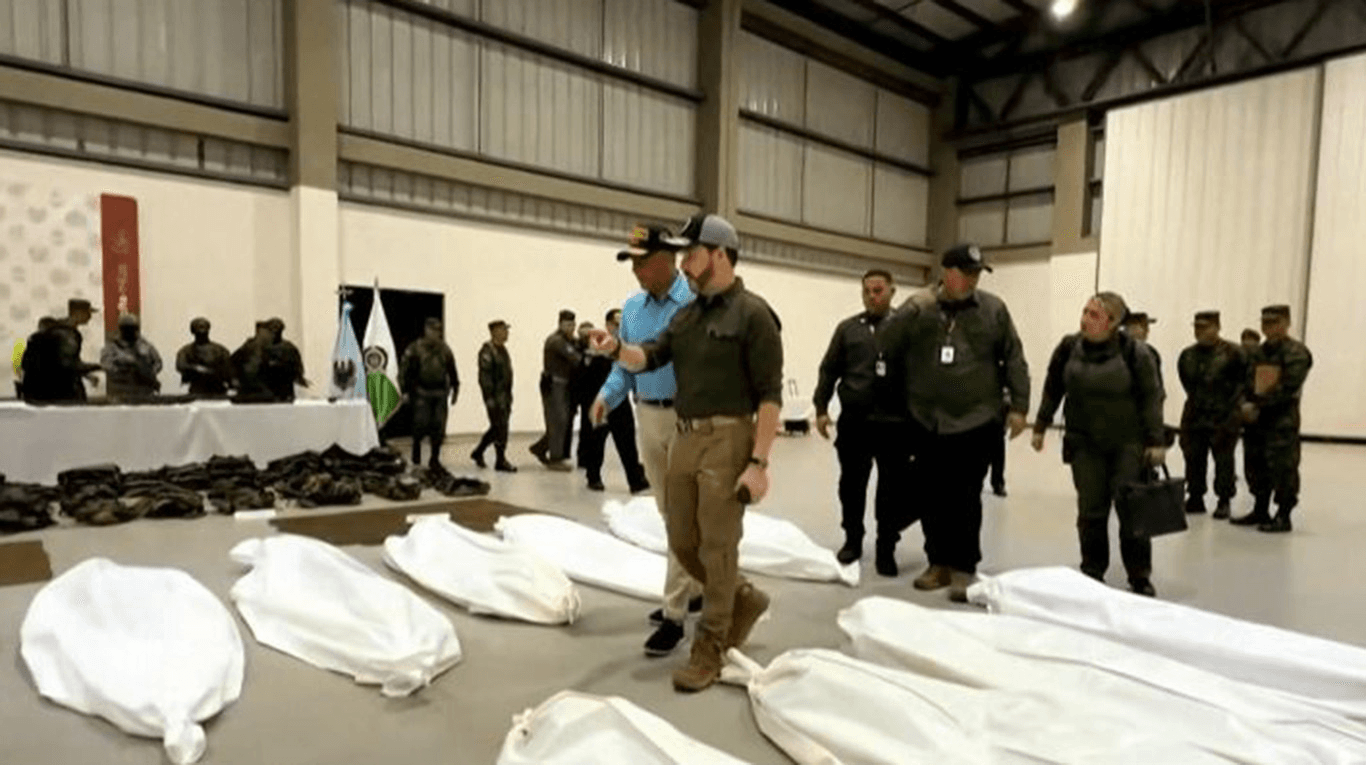
Before continuing, I want to say what I am going to talk about in this text and what not. What I want to refer to is the way in which the results of a recent military operation were presented; in other words, at a specific moment after the fact, what was turned into an image. How the current government communicated the operation, showing bodies in white bags and the president walking among them. There is an image and, if there is an image, there is an aesthetic; it’s that, and only that, I’m going to refer to, what someone decided to show, how they decided to show it, and what that says about us.
And I want to make it clear what I’m not going to talk about, because of the Colombian context, where a topic like armed conflict is so complex. I’m not going to talk about the military operation itself; I don’t have the background or the legal or war knowledge to do it. I do not intend to defend, contradict, legitimize or even evaluate the procedures, rules, ideologies or reasons of the parties involved in the act. I want to be very emphatic with this, the fact itself will not be, in any measure, the object of this text, nor do I intend to ignore or dismiss the context of internal war in which the country finds itself. Another thing I want to make clear is that the Colombian rule of law and international institutions set the legal standards for proceeding and evaluating this and other types of state actions, and that’s not what I’m going to talk about here in any way.
Nowadays, there is nothing new or surprising about the relationship between aesthetics and politics. There will already be enough one-minute videos running on networks when looking for those two terms together. But I think that where it does become interesting is when you investigate the relationship itself; what is the hierarchy between the two, who is put at whose service, and how aesthetics are organized, with their categories, within a policy that aims to build a vision of the world and mark how we relate to others in it.
One of the attempts to deepen this relationship can be seen in Susan Sontag, an American writer and cultural critic, in an essay entitled Fascism fascinante, which first appeared in The New York Review of Books in 1975 and was later collected in her book Under the sign of Saturn (1980). She is based on the case of a filmmaker, her ties to a totalitarian regime and society’s subsequent attempt to rehabilitate her as an "untamable priestess of beauty". Much of the essay is a tour of that filmmaker’s life, her films and how she tried to rewrite her past. This particular case allows Sontag to question and investigate the very relationship between art and politics in dictatorships. This relationship is described by her as a subordination. Art is subordinated to politics in any dictatorship, "on both the right and the left." And this subordination is manifested in such a way that, in these regimes, politics "appropriated the rhetoric of art", in order to promote certain ideals chosen by its function to the regime. It’s not that new categories are invented; a totalitarian regime does not create something new, what it does is use aesthetics to shape its discourse; categories like beauty, strength, purity, community are presented as aesthetic ideals that seek to hide their political function. These ideals end up representing a deviated idea, characteristic of totalitarian systems, what Sontag calls "a utopian aesthetic: that of physical perfection", where bodily perfection is exalted and the group is organized around what Sontag describes as "a figure of an all-powerful and hypnotic leader or force". I bring Sontag not to compare or equalize political contexts or systems; I bring his thought because it gives us a basis for thinking about the relationship between aesthetics and politics and what can be dangerous in it, no matter which government is involved.
After this, she wonders why one regime chooses a certain aesthetic and not another. And his answer is that this aesthetic works because there is something in the person who looks at it that responds to such images. She says that her films, propaganda documentaries from the 1930s that extolled the body as struggle, discipline, obedience and unity around a leader, are still effective today. And the reason is that beneath these values lies a romantic ideal, "their longings are still felt," an ideal to which many people remain attached. And it is at that moment when Sontag stops talking about the filmmaker and starts talking about us as a society. He says that "somewhere everyone knows that there is more than beauty at play", but that people prefer to cover this up and admire the image for what it has of beauty, avoiding taking seriously what that beauty asks to legitimize. And what it asks to legitimize are longings; Sontag gives some examples: "the cult of beauty, the fetishism of courage, the dissolution of alienation in ecstatic feelings of community", which, in other words, are the desire for order, for strength, for belonging to something. Again, it is not that a regime invents such desires. Sontag insists that they are "vivid and touching to many people" and that they remain present today under other flags, so we are all inclined to respond to them. What these regimes do is, with aesthetics, take those longings, which already exist, and give them a shape. What they want is for you to move before you can think. And what we have to take into account is that self-feeling, without reasoning, can come to legitimize ideals that are totally harmful to a society.When an image of power moves us because it is shown as a "response" and we only leave it there, in that it looks good, we are accepting what the image proposes without having discussed it. Sontag warns that this prepares "a curiously distracted acceptance of the propaganda." So, the question that leaves the viewer is what are we accepting if we don’t reflect on the aesthetics of the message, in its form.
What we legitimize with this kind of imagery is not a security policy; that’s what debates, numbers, courts, and other bodies are for. What we legitimize is a way to inhabit the problem of security. And that way of communicating, at bottom, is not related to security itself; what it does is exalt certain ways of acting that are dangerous in a society and accepted because they reach our emotions in the form of "response" to a real need. And think about it, does the message have that form because it is the only possible one, because it is necessary, or because in that way it resonates with our emotions while saying something about who sent it?
Could the results of a state action be presented without a president walking between bodies? I think so. Because presenting something as a result is not the same as the result. The image shows that something was done; it doesn’t show that it worked. You have to believe that, the image does not prove it, only affirms it. And it is not this presentation that makes a country more or less safe. So, if the form of the message is changed, what would be lost is not security; it is what serves the sender that the message has that specific form, as it can be presented as "the answer," "the one who fulfills," "the strong." That’s what I mean when I argue that the image is functional to power.
We have a real need in Colombia, security, and it is precisely this need that the image takes to make us feel that it is already being met. But the image with which something is presented to us as a result is not neutral, it comes from a point, and that must be put in the judgment of reason. We must seek to be critical enough that power responds to our needs as a society and not use the means it has to move our emotions and promote questionable interests that are functional to it.
Yes, it is true that with an image one can feel that at last someone is in control, that at last someone is doing something. And that feeling is so real that it is hard to be critical, because it is shown as the expected "response," but not asking about the forms is very dangerous. Feeling is inherent in our humanity and that’s fine, but after feeling must come questions, reflection from every angle possible, to avoid legitimizing forms in the messages of power that are not related to our needs, even if they were. would no longer be reprehensible.